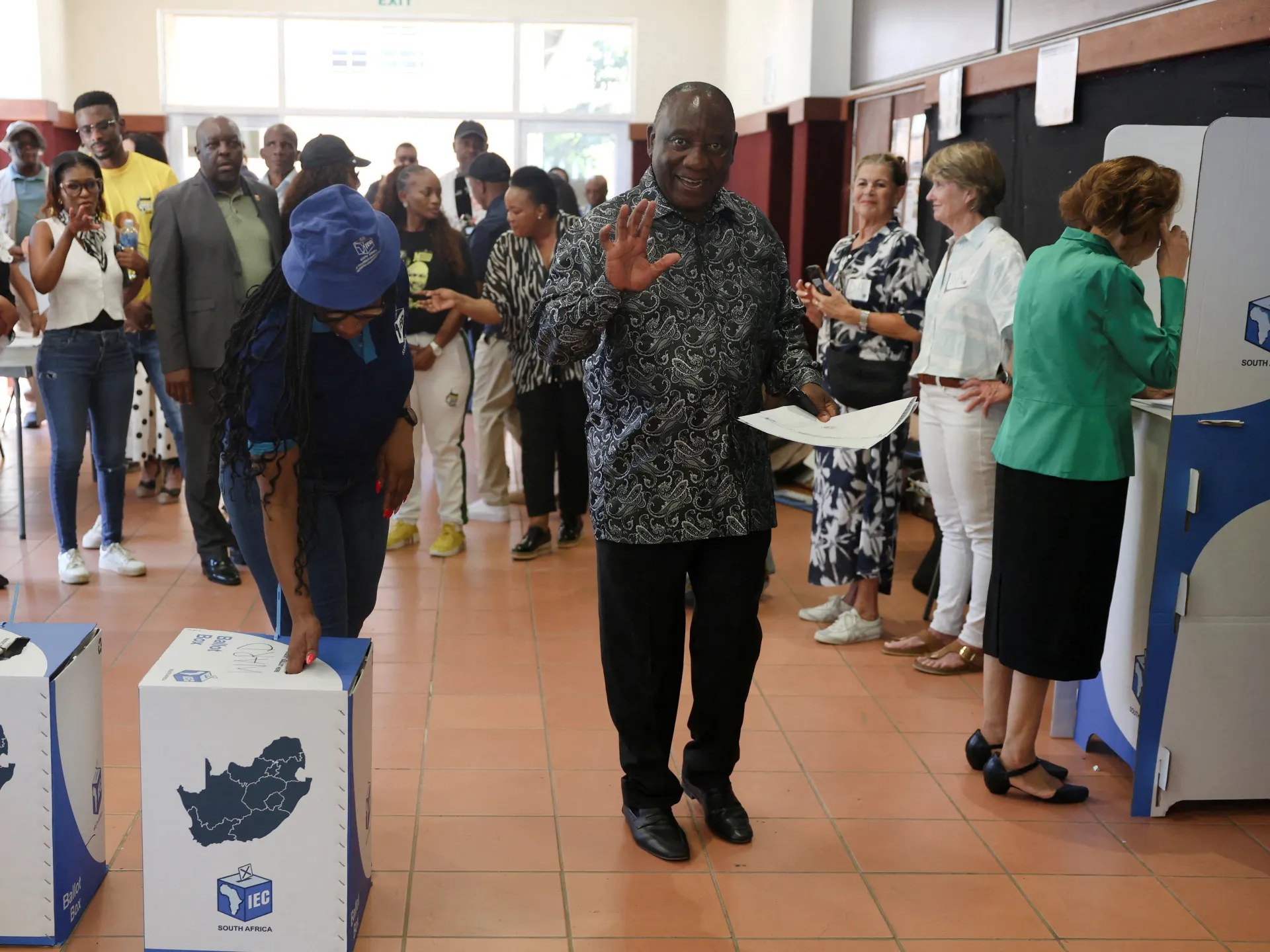
South Africa's African National Congress (ANC) plummeted to 31% of the national vote in municipal elections, a 14-percentage-point collapse from 2021 that strips the party of outright majorities in all eight major metropolitan areas and forces complex coalition talks to govern economic hubs including Johannesburg and Pretoria.
Key Takeaways
- ANC national vote share collapses to 31% (-14pp from 2021), losing all 8 metro majorities
- DA leads in Johannesburg (~35% vs ANC ~20%); MK Party emerges as 3rd force with ~10%
- 14-day coalition negotiation window opens; final results due Sunday 16:00 GMT
- Governance vacuum in Johannesburg/Pretoria threatens service delivery and fiscal credibility
- Result accelerates ANC existential crisis ahead of 2029 national elections
Executive Intelligence Brief
Electoral Arithmetic and Metro Power Vacuum
With 99% of votes counted, the ANC's 31% national share compares with 25% for the main opposition Democratic Alliance (DA) and roughly 10% for former President Jacob Zuma's uMkhonto weSizwe (MK) party, which debuted as the third-largest force. The ANC failed to breach 50% in any of the eight metros — Johannesburg, Pretoria (Tshwane), Cape Town, Ekurhuleni, eThekwini (Durban), Nelson Mandela Bay, Buffalo City, and Mangaung — creating a fragmented landscape where no single party can govern alone.
In Johannesburg, the commercial heart of the country, the DA leads with approximately 35% against the ANC's 20%, positioning DA veteran Helen Zille as a contender for the mayoralty pending coalition arithmetic. The MK Party's 10% national showing, concentrated in KwaZulu-Natal and parts of Gauteng, introduces a new kingmaker dynamic that could complicate both ANC-DA and ANC-MK alignments.
Structural Drivers of the ANC Decline
The 14-point drop extends a 15-year erosion in local election support rooted in three interlocking failures: persistent electricity load-shedding and water infrastructure decay, unemployment exceeding 34% more than three decades after apartheid's end, and corruption scandals that have hollowed out municipal administrative capacity. Voters have progressively punished the ANC at the ballot box since its 2016 peak, when it still held majorities in most metros.
ANC Secretary-General Fikile Mbalula described the outcome as 'catastrophic' on Saturday, acknowledging: 'When the people tell us we have fallen short, … the honest answer is not to argue with them but to go home and put our house in order.' The admission signals internal recognition that the party's liberation-era credibility no longer insulates it from accountability for service delivery.
Coalition Mechanics and Governance Risks
Parties now have 14 days to negotiate governing agreements before city councils convene. The DA has declared it will engage 'political parties that share a commitment to clean and accountable government, rooting out corruption, service delivery for all, the rule of law, and non-racialism' — a framework that nominally excludes both the ANC and MK Party but may require pragmatic compromise given the seat math.
Three broad coalition scenarios emerge: an ANC-DA 'grand coalition' offering stability but ideological friction; an ANC-MK alignment risking policy populism and fiscal indiscipline; or minority governments propped up by ad-hoc issue-based support, heightening administrative paralysis. Johannesburg and Pretoria, which generate a disproportionate share of national GDP, face the most acute governance vacuum.
Market and Institutional Implications
Credit rating agencies and fixed-income investors will scrutinize coalition agreements for signals on fiscal discipline, particularly regarding municipal debt management and revenue collection. The National Treasury's metro fiscal monitoring framework assumes functional councils capable of approving budgets and tariff increases; prolonged hung councils could delay critical infrastructure procurement and undermine revenue bases.
The South African Reserve Bank's monetary policy committee, while focused on inflation targeting, tracks political stability as a risk factor for capital flows. A fragmented metro landscape may also complicate the implementation of the Economic Reconstruction and Recovery Plan, which relies on municipal partnerships for energy, logistics, and spatial transformation projects.
Forward Outlook: 14-Day Window and 2029 Horizon
Final certified results are due Sunday at 16:00 GMT, after which the 14-day negotiation clock starts formally. Key milestones include: council inaugural meetings (likely late November), mayoral elections in each metro, and the ANC's own national executive committee review of the electoral debacle. The outcome will shape the party's platform and leadership calculus ahead of the 2029 national elections, where the ANC's parliamentary majority — already reduced to 40% in 2024 — faces further existential risk.