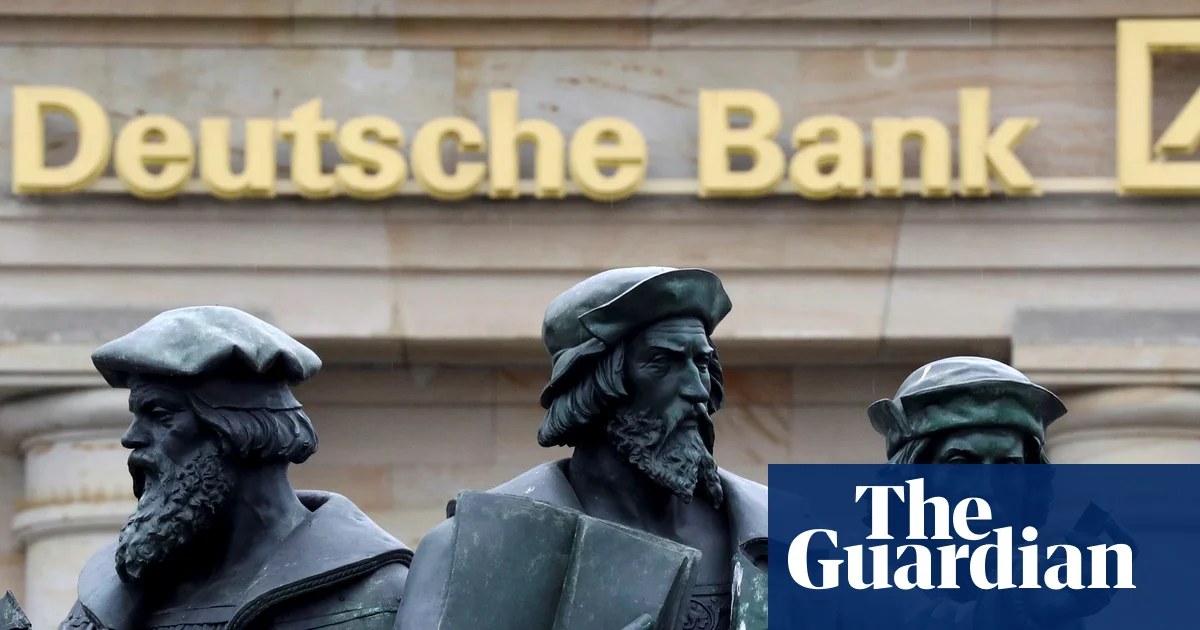
Deutsche Bank repeatedly overruled internal compliance officers to maintain profitable relationships with high-risk Russian clients, including oligarchs and state-owned enterprises, according to an investigation published Tuesday based on 15 million leaked internal documents. The reports allege the bank prioritized revenue over controls until 2021 and resisted exiting Russia even after the 2022 invasion of Ukraine, prompting a 4% share price drop in Frankfurt trading.
Key Takeaways
- 15m leaked files allege Deutsche Bank ignored compliance warnings on ~50 'most sensitive' Russian clients (Gazprom, Sibur, Deripaska) to protect profits until 2021.
- Bank resisted Russia exit after Feb 2022 Ukraine invasion, only leaving in Mar 2022; shares fell 4% on Nov 17, 2026 publication.
- Fresh allegations include ~$600m in suspicious Epstein-linked payments and accidental leak of Trump tax documents.
- Bank cites €7bn control investment (2019-2025) and 'fundamental transformation'; regulators (BaFin, ECB, Fed, DOJ) now face pressure to assess if new enforcement is warranted.
- Uncertainty remains on potential fines, current exposure to flagged clients, and whether 'record profits' adequately provision for legacy legal risks.
Executive Intelligence Brief
The 'Most Sensitive Clients' List and Russian Exposure
The investigation, coordinated across Der Spiegel, the Financial Times, the New York Times, and Le Monde, centers on a purported internal list of roughly 50 'most sensitive clients' ranked by proximity to the Kremlin and financial crime risk. Names identified in the reporting include Russia's state-owned gas giant Gazprom, petrochemicals group Sibur, and sanctioned aluminium magnate Oleg Deripaska.
According to the Financial Times, the bank expanded its Russian business until 2021 despite mounting geopolitical tensions and internal warnings. The leaked files allegedly show Deutsche Bank resisted pulling out even after the February 2022 full-scale invasion of Ukraine, only executing a U-turn to exit in March 2022. The reporting suggests competitive pressure from American rivals drove a growth strategy under CEO Christian Sewing that tolerated elevated compliance risk.
Historical Pattern and Regulatory Context
The allegations revive a pattern stretching back to the 'mirror trading' scandal, where the bank was caught laundering billions for Russian criminals, spies, and oligarchs between 2010 and 2015. The current leak suggests the cultural and structural deficiencies that enabled that episode persisted years after regulatory settlements. Deutsche Bank acknowledged in its Tuesday statement that the issues 'date back many years, in some cases as much as two decades' and asserted they had been 'addressed by its leadership' with close regulator engagement.
Epstein, Trump, and Broader Control Failures
The scope extends beyond Russia. The reports allege the bank processed nearly $600 million in suspicious payments linked to convicted sex offender Jeffrey Epstein, significantly higher than previously disclosed amounts. Deutsche Bank stated it 'regrets [its] historical relationship' with Epstein and cited 'considerable investments in strengthening controls.' Separately, the bank is accused of accidentally leaking former US President Donald Trump's tax documents to another client during his first term and keeping the breach secret from the White House. The bank cut ties with Trump in 2021 and declined to comment on specific client relationships.
Transformation Narrative vs. Market Reaction
Deutsche Bank's defense rests on a claimed 'fundamental transformation' under Sewing, citing €7 billion in direct investments in its control environment between 2019 and 2025 and record profits in 2025 and recent quarters. 'We remain committed to ensuring continuous enhancements of our control environment and a culture of integrity,' the bank stated. However, the market's immediate 4% sell-off signals skepticism that legacy risks are fully provisioned or that the cultural overhaul is irreversible.
Regulatory Outlook and Next Steps
Focus now shifts to BaFin and the European Central Bank, the bank's primary supervisors, alongside US authorities including the Federal Reserve and Department of Justice. The key monitorable is whether the leaked data triggers fresh enforcement actions, consent orders, or capital add-ons rather than just supervisory pressure. Investors should watch Q4 2026 earnings for legal provision updates and any revision to the 'most sensitive clients' remediation timeline. The bank warned it will 'act decisively' to protect confidential data contained in the leak, signaling potential legal action against the media consortium.