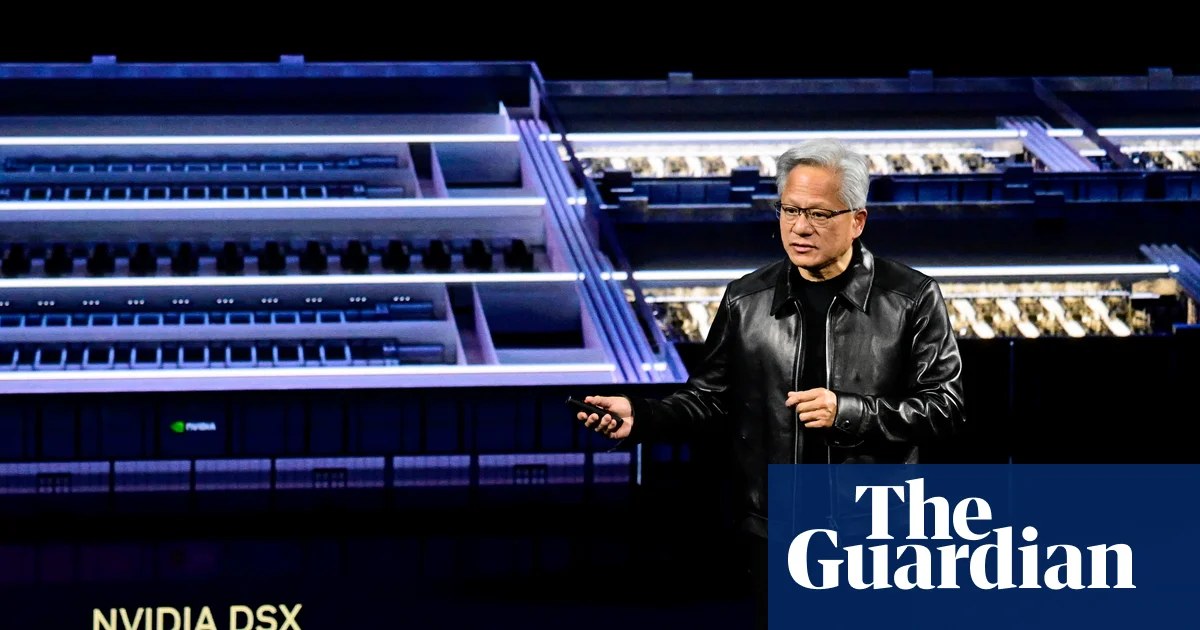
Nvidia and CEO Jensen Huang face a federal shareholder lawsuit alleging they concealed Huang's affair with a former Megaspeed executive identified by US authorities as a Chinese intelligence asset, while President Trump confirmed the FBI is investigating the matter. Shares plunged 4.3% Monday, erasing roughly $190 billion in market value.
Key Takeaways
- Federal class-action lawsuit filed in California alleges Nvidia and Jensen Huang misled shareholders by concealing affair with Alice Huang, identified by US authorities as Chinese intelligence asset.
- President Trump confirmed FBI investigation into Huang's links; Huang admitted infidelity and said he had 'absolutely no idea' the person was a spy.
- Nvidia shares fell 4.3% Monday, wiping ~$190bn in market value; lawsuit filed five minutes post-market close.
- Nvidia board launched independent investigation into whether Huang was 'target of a foreign intelligence effort'; multiple law firms investigating potential securities violations.
- Megaspeed, where Alice Huang was executive, previously investigated for potential diversion of Nvidia chips to China in violation of export controls.
Executive Intelligence Brief
Lawsuit Alleges Material Omissions on National Security Risk
A complaint filed in US federal court in California by retail investor Mark Kistenmacher accuses Nvidia and Huang of misleading shareholders by failing to disclose that Huang's relationship with Alice Huang — a former executive at Singapore-based Megaspeed — raised national security concerns threatening the chipmaker's reputation and business prospects. The suit, filed five minutes after Monday's market close, cites a New York Times report stating US authorities concluded Alice Huang was a Chinese intelligence asset.
The complaint alleges Nvidia's prior statement to the Times — characterizing Huang's interactions as 'not unusual or unexpected' and noting 'meetings with customers are part of a CEO's job' — was 'materially false and misleading at the time it was made because Jensen Huang had an affair with Alice Huang.' It further accuses the company of false statements regarding its relationship with Megaspeed, which has been investigated over suspicions of diverting Nvidia chips to China in violation of US export restrictions.
FBI Investigation Confirmed; Board Launches Independent Probe
President Donald Trump confirmed Monday that the FBI is investigating Huang's links with Alice Huang, stating: 'I know the FBI is looking into it in terms of something else, and I think that he'll be in good shape.' Trump added he spoke with Huang Sunday, who said he 'had absolutely no idea that the person in question was a spy.' Huang admitted infidelity in a Sunday statement without naming the other party.
Nvidia announced Sunday it was conducting an independent investigation into reports Huang was the 'target of a foreign intelligence effort.' The board's move follows Huang's October 30 interview assertion that 'we've studied all their [Megaspeed] deployments of our GPUs and counted every one. And I think the US government also has as well.' Megaspeed previously stated it acted 'fully in compliance with all applicable laws, including US export control regulations.'
Market Impact and Governance Fallout
Nvidia shares closed down 4.3% Monday, reducing the $4.3 trillion company's market value by approximately $190 billion — one of the largest single-session absolute losses in market history. Multiple US law firms have announced investigations into whether Nvidia misled investors. The developments thrust the world's most valuable semiconductor company into a governance crisis, with Huang — co-founder and CEO since 1993 — facing simultaneous legal, regulatory, and national security scrutiny.
Export Control Compliance Under Renewed Scrutiny
The lawsuit revives focus on Nvidia's export-control compliance amid tightening US restrictions on advanced AI chip shipments to China. Allegations that Megaspeed may have diverted Nvidia GPUs to China, combined with Huang's personal connection to an alleged intelligence asset, create a dual-track risk: potential civil and criminal liability for export violations, and securities fraud exposure for alleged disclosure failures. The FBI investigation adds a criminal counterintelligence dimension that could implicate sensitive technology transfer protocols.
Forward Outlook: Investigations and Leadership Uncertainty
Three parallel investigations now converge: Nvidia's board-led independent review, the FBI counterintelligence probe, and the federal securities class action. Huang pledged in an open letter: 'I support the investigation and will cooperate fully. I love our country and our company. I am committed to protecting Nvidia and supporting America's national security.' Key milestones include the board's investigation findings, any FBI or DOJ charging decisions, SEC review of disclosure adequacy, and the class-action certification process. Huang's continued tenure as CEO remains uncertain pending outcomes.