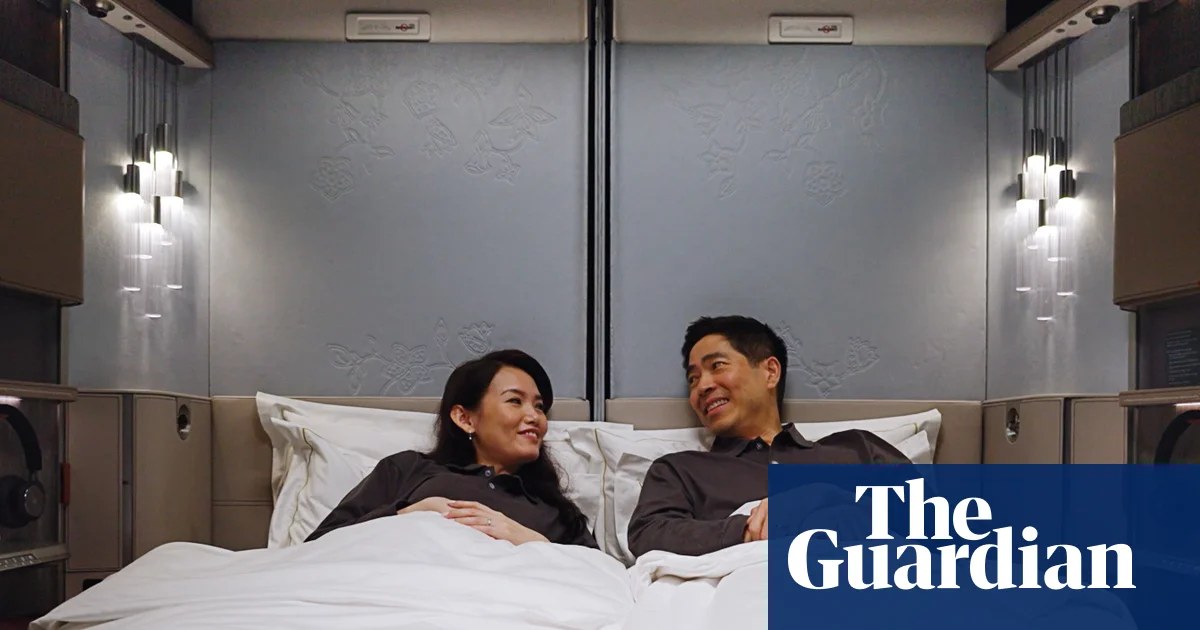
Singapore Airlines will invest S$2 billion (£1.2 billion) to retrofit its fleet with new first-class suites featuring a 203cm-by-152cm double bed, select business-class seats that convert into double beds, curved privacy doors, 4K screens, and fleet-wide Starlink internet, with entry into service from the second half of 2027.
Key Takeaways
- Singapore Airlines commits S$2bn (£1.2bn) for cabin retrofit launching H2 2027, featuring a 203cm x 152cm first-class double bed — larger than a UK standard double mattress.
- Select business-class seats convert to double beds; all cabins receive 4K screens, Starlink internet, improved meals, and economy gains legroom and storage.
- Investment responds to market share loss versus Emirates ($5bn retrofit, 2022), Air France (La Première, 2024), and British Airways (A380 first class, forthcoming).
- Structural tailwinds: 13% rise in global billionaires (AI wealth effect) expands £10k+ ticket demand; Asia-Europe rerouting boosts SIA traffic vs Gulf hubs.
- Key unknowns: aircraft types/quantity covered, capex phasing, Starlink pricing tiers, and certification timeline for novel double-bed seat structure.
Executive Intelligence Brief
First-Class Suite Specifications and Premium Positioning
The centrepiece of the upgrade is a double bed formed by two adjoining first-class seats, spanning 203cm (80 inches) in length and 152cm (60 inches) in width. That exceeds a standard UK double mattress (190cm by 135cm) by 13cm in length and 17cm in width. The bedding package includes a mattress topper from German luxury manufacturer Paradies, a duvet, and a choice of pillows. Curved sliding doors provide enhanced privacy, while 4K ultra-high-definition touchscreens replace existing entertainment displays.
Singapore Airlines said select business-class seats will also be configurable as double beds, extending the sleeping proposition beyond the first-class cabin. One-way first-class fares on key routes already exceed £10,000, placing the product squarely in the ultra-premium segment where the carrier competes with Emirates' refreshed suites, Air France's new 'La Première' cabin, and British Airways' forthcoming A380 first-class product.
Competitive Context: The 'Race to the Top' in Premium Travel
The announcement arrives amid a broad escalation in premium cabin investment across legacy carriers. Emirates launched a fleet-wide $5 billion retrofit programme in 2022, refreshing first-class suites with more space and updated technology. Air France debuted 'La Première' this year, marketing a private-jet-style experience. British Airways is developing a new first-class cabin for its Airbus A380 fleet. Singapore Airlines, ranked the world's best airline by Skytrax in 2026, acknowledged it has lost market share to rivals who invested heavily in cabin upgrades earlier.
The premium arms race is underpinned by structural demand shifts. The global billionaire population grew 13% amid an AI-driven equity rally, expanding the addressable market for £10,000-plus tickets. Simultaneously, Singapore Airlines has captured traffic rerouted between Asia and Europe away from Gulf hubs due to Middle East airspace complications, providing a revenue tailwind to fund the S$2 billion outlay despite elevated fuel costs.
Fleet-Wide Enhancements: Economy, Connectivity, and Ancillary Revenue
The programme is not limited to the front of the aircraft. Economy passengers will receive increased legroom and a redesigned personal-item storage layout. All cabins gain an expanded meal selection and upgraded in-flight entertainment. Critically, the airline confirmed fleet-wide internet connectivity via SpaceX's Starlink satellite network, a significant differentiator as carriers race to deploy low-earth-orbit broadband. Starlink's high bandwidth enables new ancillary revenue streams — premium Wi-Fi tiers, real-time shopping, and streaming partnerships — across all fare classes.
Rollout Timeline and Execution Risks
Singapore Airlines stated the new cabins will be introduced from the second half of 2027. The airline did not disclose the number of aircraft covered, the fleet types involved (A350, 777-9, A380), or the phasing sequence. Execution risk centres on supply-chain lead times for bespoke suite hardware, regulatory certification of the novel double-bed seat structure, and Starlink aviation terminal installation slots. The S$2 billion capital commitment will be scrutinised against the carrier's free cash flow generation and the timeline for premium yield recovery.
Forward Outlook: Metrics to Monitor
Investors and analysts should track three key indicators: first, the premium cabin load factor and yield premium relative to Emirates and Qatar Airways on shared routes (London, Sydney, Frankfurt, New York); second, Starlink take-rate and average revenue per user across cabins; third, competitive counter-moves — particularly whether Emirates accelerates its retrofit or Qatar Airways unveils a 'Qsuite 2.0' double-bed product. The H2 2027 entry-into-service date positions Singapore Airlines to capture the 2028-2029 premium travel cycle, assuming on-time delivery.