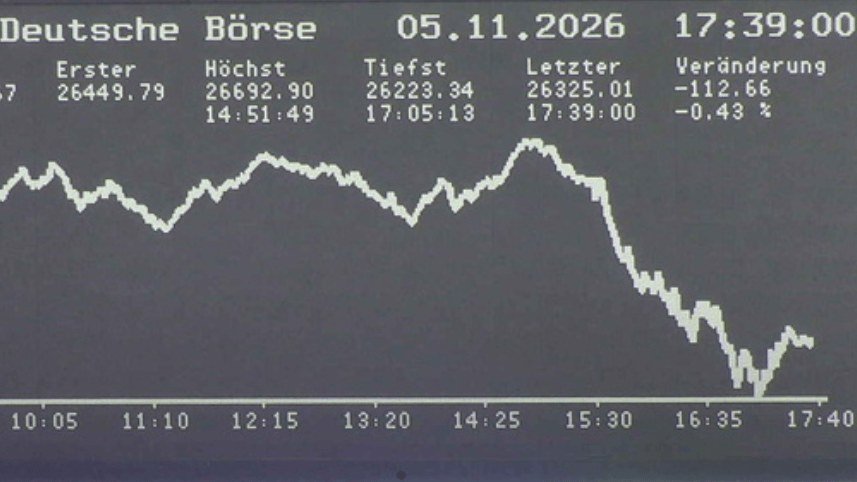
The Dax surrendered an intraday record high of 26,685.23 points to close 0.4% lower at 26,325 on Thursday, as a sharp selloff in US technology stocks — led by chipmakers — rippled across European markets. The Nasdaq dropped more than 5% at the US open, extending a rout in artificial-intelligence-exposed equities that inflicted double-digit losses on German semiconductor equipment and chip manufacturers.
Key Takeaways
- Dax hit record 26,685 intraday but closed at 26,325 (-0.4%) after Nasdaq plunged >5%.
- German chip sector hammered: Infineon -8%; MDAX/SDAX equipment names -9% to -14%.
- Index had rallied >5% (1,400 pts) in two weeks, breaking 25,000–25,600 range.
- Reversal tests breakout validity; 25,600 now key technical support.
- Next catalysts: US semiconductor earnings guidance, CPI/retail sales for Fed path.
Executive Intelligence Brief
Intraday Reversal Erases Record Gains
Early optimism driven by US midterm outcomes, hopes for diplomatic progress in the Middle East, falling energy prices, and declining bond yields had propelled the Dax to a fresh all-time high. Within minutes of the US cash open, those gains evaporated. The index had rallied more than 5% — roughly 1,400 points — over the prior two trading weeks, breaking sustainably above a 25,000–25,600 consolidation range that had capped the market since early autumn.
Semiconductor Supply Chain Bears the Brunt
The selloff was highly concentrated. Infineon, the Dax’s primary chip exposure, lost more than 8%. In the MDAX, Siltronic, Aixtron, Nemetschek, and Suss Microtec declined between 9% and 14%. SDAX names LPKF and PVA Tepla fell approximately 12%. The breadth of losses across wafer-processing, deposition, and lithography equipment makers signals a broad reassessment of the semiconductor capital-expenditure cycle rather than idiosyncratic risk.
Technical Context: Breakout Tested Immediately
Thursday’s reversal represents the first serious test of the breakout from the 25,000–25,600 range. The index closed below the session’s high but remained above the range ceiling, leaving the breakout technically intact. However, the speed of the prior advance — 1,400 points in two weeks — left little consolidation room, increasing vulnerability to profit-taking if US tech weakness persists.
Forward Outlook: US Earnings and Macro Catalysts
Market focus shifts to forthcoming earnings guidance from major US AI-exposed semiconductors and macroeconomic data — notably US CPI and retail sales — that will shape Federal Reserve rate expectations. High-growth technology valuations remain acutely sensitive to the discount rate; a repricing of Fed cuts would disproportionately pressure the names that led the Dax’s recent rally.