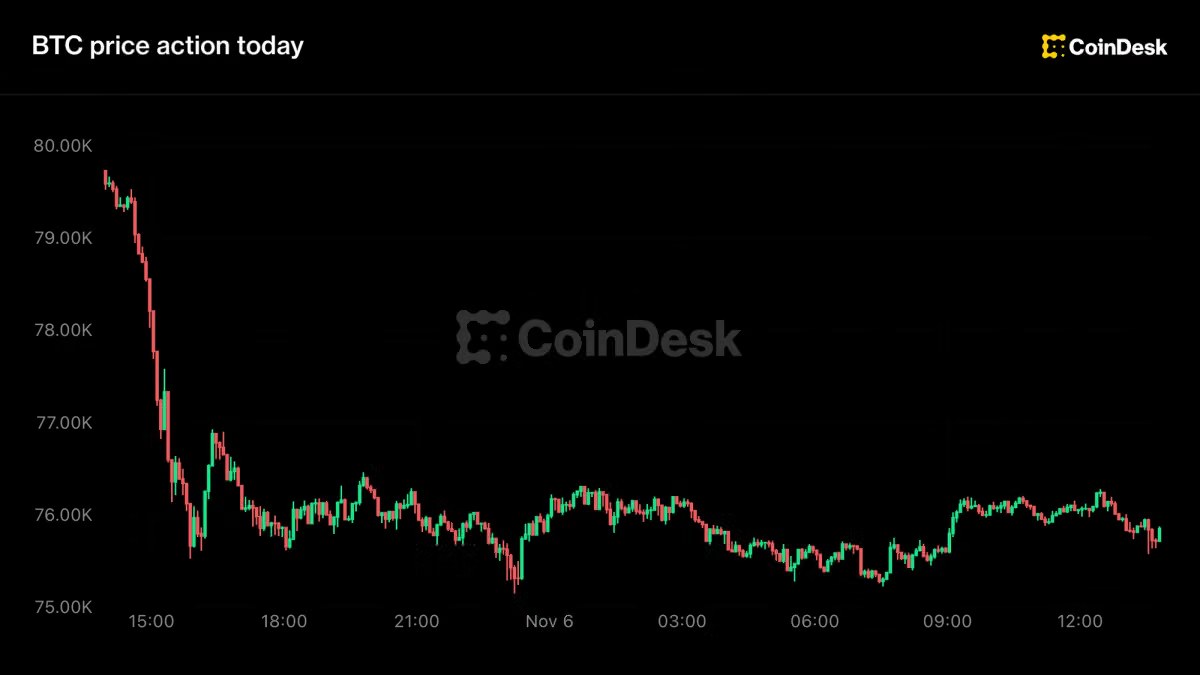
U.S. equities surrendered most of Friday's early gains as the Nasdaq closed up just 1.1% after a 2% intraday surge, while Bitcoin flatlined near $75,750. Morgan Stanley reported hedge fund net leverage plunged 5% — the fifth-largest single-day drop since 2010 — pushing leverage to the bottom decile and underscoring fragile risk appetite ahead of next week's inflation data.
Key Takeaways
- Nasdaq pared 2% intraday gain to close +1.1%; S&P 500 +0.3%; Dow -0.45% — rebound lacked conviction
- Hedge fund net leverage fell 5% (5th largest drop since 2010) to bottom decile; AI exposure still 32% of absolute positions
- Bitcoin flat at $75,750, weakest since September rate hike; break below $75K targets mid-August lows
- IREN +20% on AI deal with GPU prepayment; $4B revenue target pulled forward to early 2027
- Next week's CPI (Nov 13) and PPI (Nov 14) now dominate Fed calculus; December hike odds uncertain
Executive Intelligence Brief
Equity Rebound Loses Momentum Into Close
The Nasdaq 100, which tumbled 5.5% Thursday, opened Friday with a 2% gain but steadily erased ground through the session. The S&P 500 managed only a 0.3% advance after a 4% drop the prior day, while the Dow Jones Industrial Average extended losses with a 0.45% decline. The iShares Semiconductor ETF (SOXX) rose 3% but closed the week down more than 14%, reflecting the severity of the AI-sector rout.
Bond yields rose modestly after a far stronger-than-expected October jobs report. However, given the equity market turbulence and the Federal Reserve's inflation focus, next week's CPI and PPI releases are likely to play stronger roles in policy decision-making than the payrolls print.
Record Deleveraging Exposes Fragile Positioning
Morgan Stanley's derivatives desk quantified the leverage unwind: U.S. long/short hedge fund net leverage declined 5% day-over-day on Friday, the fifth-largest single-day drop since 2010. Net leverage now sits in the bottom decile since 2010. Hedge funds are now underweight AI stocks relative to market-cap weights, yet AI still accounts for 32% of absolute exposure — a concentrated position vulnerable to further forced selling.
Retail selling in the first 90 minutes of Friday's session was the second-largest since 2016, based on bank estimates. Equities are now trading in a more correlated fashion, a pattern that often signals broadening risk reduction rather than stock-specific rotation.
Bitcoin Trapped in Equity Correlation
Bitcoin traded in a very tight range throughout the session, holding at $75,750 — virtually unchanged from Thursday's equity close. The cryptocurrency has drifted to its weakest level since the Fed's mid-September rate hike. A break below $75,000 would return prices to mid-August levels, removing a key psychological support.
The tight correlation with tech equities persists: as the Nasdaq narrowed its opening gain, Bitcoin edged down to $75,400. With hedge funds deleveraging aggressively and AI exposure still elevated at 32% of absolute positions, further equity pressure could transmit directly to digital assets.
Data Center Names Show Divergence; IREN Leads on AI Deal
IREN surged 20% after reporting quarterly results that included an expanded agreement with a top frontier AI company. The client prepaid a sizable portion of GPU costs, reducing IREN's need to raise additional capital. The company now expects to hit its $4 billion annualized revenue target early next year, ahead of previous December guidance.
Peers Keel Infrastructure (KEEL), Bitdeer (BTDR), Riot Platforms, and Hut 8 gained 5-8%, but the sector as a whole remains down 50% or more in recent weeks. OpenAI CFO Sarah Friar separately confirmed continued data center investment and capital raising, stating the midterm elections haven't dramatically changed the company's trajectory.
Policy Crosscurrents Ahead of Inflation Data
December rate-hike odds rose above 70% after the jobs report but have since moderated. The tension centers on whether the AI-led selloff and tightening financial conditions will prompt the Fed to pause, or whether sticky inflation in next week's CPI and PPI prints will reinforce the hiking bias. Political developments — including Susie Wiles' replacement by Stephen Miller as Trump's chief of staff — add another layer of uncertainty to the policy outlook.